 English
 français
 Deutsch
 Español
 italiano
 русский
 português
 العربية
 ไทย
ไทย čeština
 Polska
Mechanical seals are widely used in pumps and rotating equipment to control leakage between a rotating shaft and stationary housing. However, choosing a seal is not simply a matter of finding a nearby supplier or matching a shaft diameter. The correct solution depends on the equipment, operating conditions, fluid, pressure, temperature, seal arrangement, and materials.
For engineers and maintenance teams, several practical questions often come up: Where can I find mechanical seals near me? Which statement about mechanical seals is most accurate? Why do mechanical seals fail? How do mechanical seals work in refineries? And how long do mechanical seals last?
This guide addresses these questions from a selection and reliability perspective.
Where Can I Find Mechanical Seals Near Me?
The fastest way to find a suitable mechanical seal is usually to identify the pump model and existing seal specification before searching for a supplier. Local industrial distributors may be convenient when an emergency replacement is required, while specialist manufacturers can be useful when an OEM-equivalent, customized, or difficult-to-source seal is needed.
When comparing water pump mechanical seal suppliers, check whether they can provide:
Standard and OEM replacement seals
Cartridge and dual cartridge designs
Mechanical seal spare parts
Stationary and rotating rings
Shaft sleeves and O-rings
Material customization
Dimensional drawings and technical support
Seals for specific pump brands or models
For example, China Sealcon lists elastomer bellows seals, metal bellows seals, O-ring seals, single cartridge seals, dual cartridge seals, Flygt mechanical seals, stationary seats, and seal spare parts in its product range.
For urgent purchasing, proximity matters, but technical compatibility is usually more important than geographical distance.
Which Statement About Mechanical Seals Is Most Accurate?
The most accurate statement is:
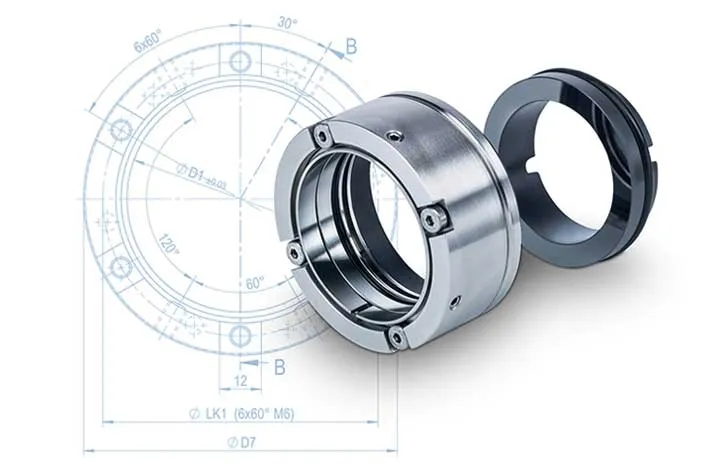
A mechanical seal is a precision-engineered sealing assembly whose performance depends on the interaction of seal faces, secondary seals, loading elements, shaft condition, fluid properties, and operating conditions.
A mechanical seal is not simply a rubber ring or a single carbon seal ring. Its main sealing interface normally consists of a rotating ring and a stationary ring, while springs, bellows, O-rings, sleeves, glands, and other components support the sealing function.
China Sealcon describes the mechanical seal ring as a key component consisting primarily of moving and stationary rings, with auxiliary sealing elements and elastic components supporting face contact and compensation.
This distinction is important when comparing types of pump seals. A balanced seal, for example, is designed to reduce the hydraulic closing force acting on the faces and can therefore be appropriate for particular pressure and operating conditions.
Common Mechanical Seal Configurations
Seal Configuration | Main Characteristic | Typical Consideration |
Single mechanical seal | One primary sealing interface | General pump service |
Cartridge mechanical seal | Preassembled unit | Easier installation |
Dual cartridge seal | Two sealing interfaces | Hazardous or difficult fluids |
Bellows mechanical seal | Bellows provides secondary sealing/loading | Specialized temperature or fluid service |
O-ring seal | O-ring provides secondary sealing | Broad industrial use |
Metal bellows seal | Flexible metal bellows | High-temperature or demanding service |
Flygt mechanical seal | Pump-specific replacement design | Submersible/wastewater applications |
Why Do Mechanical Seals Fail?
Mechanical seals can fail for many reasons, and identifying the failure mechanism is more useful than simply replacing the damaged component.
China Sealcon identifies incorrect installation, vibration, heat problems, and human error among common causes of mechanical seal failure.
Dry Running
Mechanical seal faces generally depend on an appropriate lubricating film. If the pump operates without adequate liquid, excessive heat can quickly damage the faces.
Excessive Vibration
Pump misalignment, bearing problems, cavitation, an unbalanced impeller, or poor foundation conditions can introduce vibration. This movement can disturb the seal faces and accelerate wear.
Incorrect Material Selection
A carbon sealing ring that performs well in clean water may not be appropriate for every chemical or abrasive application. Face materials must be selected according to the fluid, temperature, pressure, speed, and contamination level.
Carbon is popular because carbon/graphite offers low friction, natural lubrication, thermal conductivity, and corrosion resistance.
Damaged Shaft or Sleeve
A worn mechanical seal shaft sleeve can create leakage even when the seal faces themselves are in good condition. Grooves, corrosion, burrs, and excessive runout can damage secondary sealing elements.
Excessive Temperature or Pressure
Temperature affects both seal faces and elastomers. Pressure affects face loading and can change the operating limits of the sealing arrangement.
For petroleum, natural gas, and chemical services, API 682 provides requirements and recommendations for shaft sealing systems where reliability and emissions control are particularly important.
How Do Mechanical Seals Work in Refineries?
Refineries use mechanical seals on pumps handling hydrocarbons, chemicals, hot fluids, and other process media. The sealing challenge is more demanding than in many ordinary water-pump applications because leakage can create safety, environmental, and production risks.
API 682 classifies shaft sealing arrangements according to how many seals are used and how buffer or barrier fluids are managed.
Single-Seal Arrangements
A single seal uses one primary sealing interface. The process liquid normally provides lubrication and cooling, while controlled leakage passes across the seal faces.
Dual-Seal Arrangements
A dual cartridge seal uses two sealing interfaces. The area between the seals can contain a buffer or barrier fluid.
John Crane explains that API 682 Arrangement 2 uses two seals with a buffer zone maintained below seal-chamber pressure, while Arrangement 3 uses an externally supplied barrier fluid at a pressure above the seal chamber.
This configuration can provide additional containment for hazardous, volatile, toxic, or difficult-to-seal refinery fluids.
Why Cartridge Designs Are Common in Refinery Service
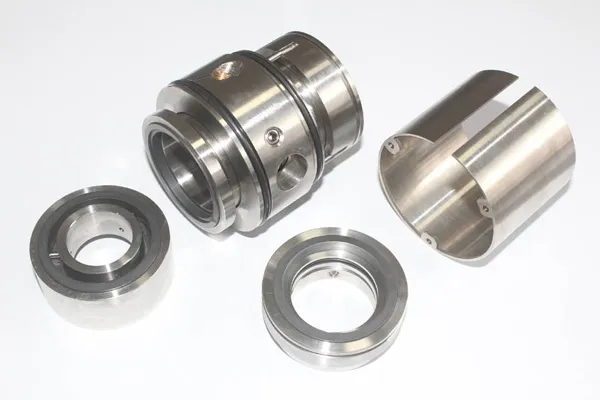
A cartridge mechanical seal assembly integrates major components such as seal rings, secondary seals, gland plate, and sleeve into a preassembled unit. API 682 defines a cartridge seal as a self-contained unit that is preassembled and preset before installation.
This can reduce installation variables and make maintenance more repeatable.
How Long Do Mechanical Seals Last?
There is no universal service life for a mechanical seal. A seal operating in clean, cool water under stable conditions can have a very different lifespan from one handling abrasive slurry, hydrocarbons, high-temperature fluids, or corrosive chemicals.
Operating Factor | Effect on Seal Life |
Clean fluid | Generally supports longer life |
Abrasive particles | Increase face wear |
Dry running | Can cause rapid damage |
High temperature | Accelerates material degradation |
Excessive pressure | Increases sealing stress |
Shaft misalignment | Promotes uneven wear |
Vibration | Reduces face stability |
Correct material selection | Supports longer service |
Proper flush/barrier system | Improves difficult-service reliability |
Correct installation | Reduces premature failure |
For API 682 applications, the standard establishes an objective that seals should operate continuously for 25,000 hours without replacement, subject to the specified conditions and scope of the standard. This should not be interpreted as a guaranteed life for every mechanical seal.
In practice, seal life is strongly influenced by equipment condition and process control.
How to Extend Mechanical Seal Service Life
Instead of waiting for visible leakage, maintenance teams can improve reliability through condition monitoring and proper operating practices.
Control Pump Operating Conditions
Avoid extended operation outside the pump's recommended flow range. Cavitation, excessive recirculation, and unstable operation can increase vibration and seal-face loading.
Maintain the Seal Support System
For dual seals, maintain the correct buffer or barrier fluid pressure, cleanliness, temperature, and circulation.
Select Compatible Materials
A carbon seal ring manufacturer or mechanical seal supplier should be able to provide material options suitable for the actual process fluid. Common materials include carbon, ceramic, silicon carbide, tungsten carbide, stainless steel, PTFE, and different elastomers.
Keep Spare Parts Available
For critical pumps, stocking China pump parts such as seal rings, O-rings, springs, sleeves, and complete cartridge assemblies can reduce downtime.
China Sealcon provides individual sealing rings, springs, O-rings, sleeves, and glands as mechanical seal spare parts, allowing maintenance teams to replace selected components where appropriate.
FAQ About Mechanical Seals
Where can I find mechanical seals near me?
Start with local pump distributors and industrial seal suppliers, then compare them with specialist manufacturers. Always provide the pump model, shaft size, seal type, operating conditions, and existing seal information.
Why do mechanical seals fail so often?
Premature failure is commonly associated with dry running, vibration, incorrect installation, unsuitable materials, excessive temperature or pressure, and damaged shafts or sleeves.
How do I know whether I need a dual cartridge seal?
Dual seals are generally considered when improved containment, a buffer fluid, or a pressurized barrier system is required. The final choice should be based on the process fluid and equipment operating conditions.
Are Flygt mechanical seals interchangeable with standard pump seals?
Not necessarily. Flygt mechanical seal replacements should be checked against the specific pump model, dimensions, seal configuration, and material requirements.
What is the purpose of a carbon seal ring?
A carbon seal ring commonly functions as one of the mating faces in a mechanical seal. Its low friction, thermal properties, and self-lubricating characteristics make carbon/graphite useful in many applications.
How long should a mechanical seal last?
There is no fixed lifespan. Service life depends on the fluid, pressure, temperature, speed, vibration, materials, installation quality, and seal support system. API 682 provides specific reliability objectives for seals within its applicable scope.
Related Blog
-
China Water Pump Spare Parts: Complete Guide to Water Pump Components and Parts List
-
Different Types of Pump Seals: A Complete Guide to Pump Mechanical Seal Types
-
Mechanical Seal Stationary Seat: Complete Guide to Stationary Parts Sealing and Seal Seat Selection
-
Flygt Pump Mechanical Seal Installation Guide: Choosing Compatible Replacement Seals for Flygt Pumps
-
How to Measure Mechanical Seal Size and Repair a Mechanical Seal
-
How to Replace a Mechanical Seal on a Water Pump